Keith L. Bildstein, Ph.D.
Hawk Mountain Sarkis Acopian Director of Conservation Science
The walk-in trap used to capture vultures at the Eliza Cove dump (Photo by Brandon Breen)
An e-mail from birding phenom Noah Strycker earlier this week reminded me just how interconnected our natural world of vultures really is. Noah’s recent “big-year” book Birding Without Borders has made him an international birding super-star, and that is what brought him to Hawk Mountain for a fall lecture last autumn. While at Hawk Mountain, Noah mentioned that he would leading a birding cruise in and around the Falkland Islands in March 2018, and I suggested that he be on the lookout for our color-banded striated caracaras there. (You may recall that we have banded more than 1200 of these enigmatic raptors over the past eight years on the Falklands, and I was certain Noah would spot one or more of them on his visit.) And indeed he did–R36 yellow, a juvenile we had banded on one island last summer, was seen by Noah almost 20 miles away on another island, a sighting that adds significantly to our knowledge of movement ecology in the species.
Yellow number 10 at Gypsy Cove on March 13 2018 (photo by Noah Strycker)
Yellow number 37 at Gypsy Cove on March 13 2018 (photo by Sarah Gutowsky)
Noah, who was traveling on the M/V Ocean Adventurer, chartered by Quark Expeditions on a 33-day Atlantic Islands voyage from Ushuaia to Cape Verde, stopped for the day on March 13, and he and some others on the tour went to Gypsy Cove near Stanley to look for birds. They spotted two wing-tagged turkey vultures, a species we have studying and tagging in the Falklands since 2006. One was tagged with number 10 yellow, the other with 37 yellow, two individuals that had been tagged as adults on two successive days in early July 2010 at a municipal garbage tip near Stanley. That the two were still hanging around together more than seven years later is testimony to the longevity of the tags (take a look at them on the accompanying photos), as well as to the relationship of the two birds involved, both of which most likely roost with dozens of other turkey vultures on one of two small tussac islands near by.
Although we’ve had hundreds of reports of many of the 52 vultures we have tagged in the Falklands, Noah’s observations are the first in several years to report two birds simultaneously.
A wing-tagged vulture at a municipal garbage tip near Stanley in 2008 (Photo by Alan Henry)
Somewhat surprisingly, most of the tagged birds have remained near Stanley (and the dump) confirming that human rubbish plays an important role in the diets of these birds. I say “confirming” because a study of regurgitation pellets from turkey vultures collected by Amélie Augé of the South Atlantic Environmental Research Institute suggests a strong rubbish relationship. Amélie collected her pellets in and around Stanley in 2015 and published her work in the journal Polar Biology in 2016. Most of the regurgitation pellets she collected contained “anthropogenic debris,” including plastic, glass, paper, fabric, and/or aluminum in addition to more natural remains. The relatively low human density of the Falklands (fewer than 3,000 on an archipelago the size of Connecticut) emphasizes the extent to which even small numbers of people can influence and contaminate the diets of raptors even on relatively remote areas.
I look forward to re-connecting with yellow 10 and yellow 37, as well as other wing-tagged turkey vultures on my next visit to the Falklands in August. Assuming I do re-connect, I will let you know.
Keith L. Bildstein, Ph.D.
Hawk Mountain Sarkis Acopian Director of Conservation Science and
Jean-François Therrien, Ph.D.
Hawk Mountain Senior Research Biologist
We’ve all seen the classic cartoons of iconic “desert” vultures; the ones featuring cacti, watering-holes and, of course, thirsty cowboys. But just how true-to-ecological-life are these cartoons? Not much it seems.
The two of us have been surveying and trapping black and turkey vultures in the Sonoran Desert of southwestern Arizona for five years now, and the picture that emerges from our studies is quite different than that portrayed in the cartoons.
Keith Bildstein and Jean-Francois Therrien at work in the Sonoran Desert
In reality both black and turkey vultures are far less likely to be found in the interiors of expansive desert than along their edges, as well as in pockets of human-dominated landscapes within the desert where water is pumped to the surface for irrigation.
A bit of background helps. The Sonoran Desert, our principal Arizona study site since 2014, differs from America’s three other deserts, the Mohave, the Chihuahuan, and the Great Basin, in having relatively mild winters. Because of this, small numbers of black and turkey vultures occur in the Sonoran year-round, and we have been able to study their movements seasonally. It turns out that most of the birds do not occur in the so-called “desert proper.” In fact, most of the birds occur in relatively small parcels of irrigated agricultural lands that consist of enormous dairy farms crowded with 10,000 to 100,000 or more cows, and others that are covered with 1,000s of acres of leafy vegetables. In the first, natural livestock mortality provides black and turkey vultures the chance to feed on relatively fresh cattle carcasses daily. And not surprisingly, that is what most of vultures do. So much so, that we routinely set our traps to catch and tag vultures at or on such farms.
But dead cows are not the only carcasses that attract the vultures to these sites.
The Central Arizona Project, a massive construction including a more than 330-mile-long diversion canal, channels millions of gallons of water from the Colorado River into central and southern Arizona, providing surface water sufficient for the dairy farmers to grow the hay needed to feed the millions of dairy cows in the region. It also creates enough wetlands to attract fish-eating ospreys and other waterbirds, together with enough dead and dying fish to attract numerous scavenging vultures. In addition, the Colorado River, which itself runs close to the western border of Arizona, provides vegetable farmers along its course with enough water to grow kale, cabbage, and other thirsty vegetables, and in so doing attracts rodents and rabbits, which also, eventually, supply carcasses for the vultures.
All of this means that “desert vultures” are far more abundant in human-dominated landscapes away from the natural desert proper than the vulture cartoons indicate. Indeed, pumped surface water rules both the distribution and abundance of vultures in the Sonoran desert.
The water, itself, is important is it to desert-dwelling turkey and black vultures. In addition to quenching their thirst, water helps cool vultures in the hot desert. Both black and turkey vultures routinely pee on their toes and feet (the biological term is urohydrosis) to aid in evaporative cooling in the hot desert, but although turkey vultures manage to do so successfully with “metabolic water” supplied from the metabolism of their food alone, black vultures need to drink additional water to accomplish such body-surface cooling, making the latter even more beholden to available surface water. And both species certainly drink and bath in surface water, at least episodically using both pumped-irrigation and natural rain water.
So there you have it: cartoons simply don’t depict the true nature of the desert’s vultures. At least not in the American Southwest.
We plan to conduct additional roadside counts and to trap vultures in southwestern Arizona next year. We will keep you posted on what our efforts reveal about vultures and their needs as soon as we decipher them. Thank you in advance for your interest in and support of our work.
Dr. Mike McGrady, Hawk Mountain Sanctuary Research Associate
13 Feb 2018
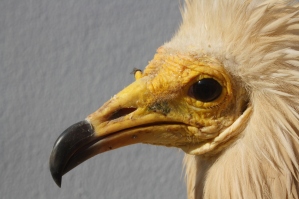
An adult Egyptian vulture that was captured and fitted with a GPS transmitter in Oman. Adult Egyptian vultures are mostly white from about 4 yreas of age, with black flight feathers. Juveniles are brown, and subaduts are mottled, becoming ever whiter with age. Photo: M. McGrady.
Like so many Old World vultures, the Egyptian vulture is globally endangered. The threats to Egyptian vultures are pretty much the same as those that other Old World vultures face, and include electrocution, changes in food availability, direct and indirect persecution, targeted and inadvertent poisoning, and hunting for the black magic market. Its endangered status and the threats notwithstanding, the Sultanate of Oman is a stronghold for Egyptian vultures, because it apparently has a healthy resident population and is a wintertime destination for a substantial number of migrants from farther north.
Since 2012, International Avian Research (IAR) has been working with the Environment Society of Oman (ESO) conducting research on Egyptian vultures in Oman. That work has included surveys on Masirah Island (which was found to be home to the second densest breeding population in the world), monitoring numbers of vultures at landfills and satellite radiotracking of vultures.
Since 2015, the Greater Los Angeles Zoo Association (GLAZA) has, through Hawk Mountain Sanctuary, supported the work of IAR. Two vultures were fitted with GPS radiotags in both 2015 and 2016, and two steppe eagles were fitted with tags in 2017—steppe eagles are also endangered; they breed mostly in central Asia, but migrate south (including into Oman) in the winter.
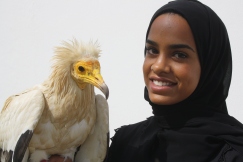
An adult Egyptian vulture fitted with a GPS transmitter and ready for release being held by an Environment Society of Oman staff member. Photo: M. McGrady
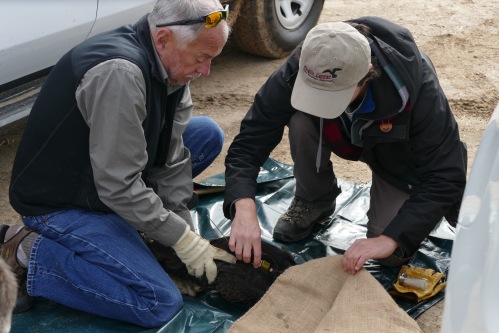
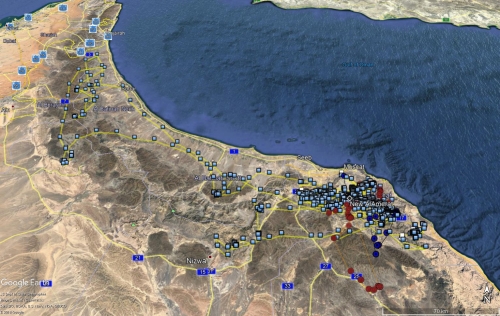
In January 2018, with the continuing support of GLAZA and Hawk Mountain Sanctuary, along with additional support from the Bernd Meyburg Foundation for Raptor Research and Conservation, IAR and its cooperators were able to capture 13 Egyptian vultures, 12 adults and one 2-year-old, and fit them with GPS tags. Since then, the birds have been doing what vultures do. Most of the vultures have spent their days ranging mostly in northeast Oman in the Hajar mountains and surrounding foothills. They have made regular visits to landfills, roosted in steep wadis in the mountains, and perched on high voltage electricity pylons. One bird has behaved a bit differently and has made at least two laps of the northern part of the country, seemingly always on the move.
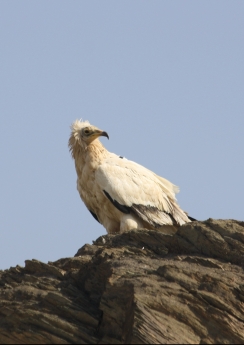
Adult Egyptian vulture in Oman in January 2018. The GPS transmitter is fitted as a backpack and can be barely seen. Photo: M. McGrady
What do or will we learn from tracking, and how can this help conserve Egyptian vultures? Well, the tracking of four vultures since 2015 has revealed that in Oman, Egyptian vultures suffer from electrocution and make regular use of landfills for feeding. The data indicate that the vultures may move around in a way so as to keep tabs on the availability of food. This, if you think about it, makes sense for a species that must find food that is not reliably available at all times. The data further suggest that ongoing upgrades to waste management in Oman, reducing the number of dumps from over 300 to 12, may not have negative effects on vultures. Indeed, improved waste management may make food resources safer for vultures and at the same time find benefits for human health, which is really good news. IAR and ESO have also used the information to educate the public, including school children, about vultures and the important ecosystem services they provide as nature’s waste managers.
The data from these newly deployed tags should help the cooperating groups do more. As we try to understand the ecology of the Egyptian vulture in order to conserve them, more data is important to the pursuit of science-based solutions. From a public education standpoint, a complete “story” that includes more individuals over more years, provides a compelling case for conservation. Also, with so many tagged adult birds, at least some are expected to be migrants, so new information on timing and routes of migration should be collected, and the location of breeding areas farther north can be determined. Such information is important in devising effective conservation strategies that span the huge range covered by migratory individuals, and it demonstrates the connectivity between breeding and wintering areas, which are sometimes separated by thousands of kilometers.
Movements of 13 Egyptian vultures caught and fitted with GPS transmitters in Oman in January 2018.
By Dr. Keith L. Bildstein, Hawk Mountain Sanctuary Sarkis Acopian Director of Conservation Science
18 Jan 2018
Monitoring the distributions and abundances of birds of prey is “key” to tracking changes in their conservation status. And this, in turn, is key to protecting them.
Indeed, lack of monitoring once-abundant Old World vultures in southern Asia during the height of their diclofenac-induced population declines in the 1980s and 1990s allowed populations of three species of widespread and common vultures to plummet catastrophically by more than 95%, unnoticed by the conservation community. Conservationists were caught by surprise at this greatest global loss of raptor populations in recorded history, necessitating expensive captive-breeding programs, which, unfortunately, some believe may offer “too little, too late” to restore these once-common species to their former status.
It was with this self-inflicted catastrophe in mind that Hawk Mountain Sanctuary embarked an ambitious intercontinental population monitoring scheme stretching from southern Canada to southernmost South America, aimed at tracking both short and long-term shifts in the distributions and abundances of populations of the world’s two most common New World scavenging birds of prey, the black and turkey vulture, along with other less common avian scavengers including caracaras and condors.
The Sanctuary’s effort began in 2004 with eight winter roadside-survey routes in Costa Rica, totaling more than 1200 kilometers. Since then, a series of more than 150 seasonal (both winter and summer) roadside counts have been undertaken across Canada, the United States, Costa Rica, Panama, Venezuela, Uruguay, Chile, Argentina, and the Falkland Islands. In 2017 we began resurveying these routes to assess the extents, if any, to which populations of scavenging birds of have changed over the years. Seven roadside-counts in central Argentina were the first to be redone this July. In late December 2017 I re-ran two of the southernmost surveys in southern Patagonian Chile. The latter two surveys are the focus of this entry.
Road sign indicating the highway goes to the end of the world (Ruta del fin del Mundo).
Although the two survey routes are just beyond the traditional southern distributions of both black and turkey vultures, both are within the distributions of Andean condors, southern crested caracaras, and chimango caracaras. (The routes, themselves, are part of the “Ruta del Fin del Mundo,” or the “Highway at the End of the World,” as the Chileans call it on their road signs.) The goal was to learn if black and turkey vultures, both of which are extending the northern limits of their ranges in North America were doing the same southward in South America. I was on my way to field work in The Falklands, and had scheduled four days to survey scavengers along the two routes I had earlier surveyed in the austral summer of 2010-2011. One route followed the northern shoreline of the Strait of Magellan for 205-kilometers from 40 kilometers south of Punta Arenas, Chile, to Punta Delgada, Chile, close to the border with Argentina. The other stretched 193-kilometers from 40 kilometers north of Punta Arenas to Puerto Natales, Chile, near the southern terminus of the Andes. Although the forecast called for rain on three of the four days, I planned to complete my surveys. Thankfully the wet weather held off, and I was able to conduct all four surveys without interruption.
An old store in a ghost town on the shoreline on the Strait of Magellan in Patagonian Chile.
Both routes took me through spectacular treeless Patagonian Steppe, desert-like regions with little vegetation that superficially resemble parts of the arid American West–open areas ideally suited for spotting both perched and flying birds of prey. Although the surveys are just “indexes” of populations of scavenging birds of prey inhabiting approximately half-a-kilometer strips along either side of the roads, they do provide relatively consistent counts of scavenging birds of prey in an area. Indeed the two counts along the first route yielded survey totals of 13 southern crested and 1 chimango caracara, and 13 crested caracaras and 3 chimango caracaras on the 19 and 21 of December 2017, respectively, supporting the validity of the survey technique’s ability to assess regional populations. The second route was more variable with no Andean condors seen on the first count day and 10 seen on the second, but all-in-all, these results and our earlier surveys suggest that populations of the three species seen had changed little across the eight years of the austral-summertime surveys. Whether this will hold for scavenger surveys in other regions remains to be seen.
However, that is only part of the story. Although I did not have time to record other species seen along the routes, I did see a number of other fascinating birds and animals, including handfuls of cinereous harriers and variable hawks, together with rheas, flamingos, black-faced ibises, southern lapwings, and guanacos. One of the most fascinating behavioral aspects of the surveys was that road–killed rabbits and other small mammals that had been hit by traffic the evening before each survey were quickly fed upon by southern crested caracaras early the following morning, with the caracaras unquestionably out-competing kelp and dolphin gulls that tried unsuccessfully to “horn-in” on the action.
The situation reminded me of what I saw several years ago while studying Old World vultures in the Masai Mara of south-western Kenya, where in early-morning, first-in-the-air, ruppells, white-backed, and lappet-faced vultures congregated at and fed upon lion- and hyena-killed prey from the previous evening’s predation events. Although my Patagonian observations occurred only across several days, there was little doubt that a daily feeding pattern existed. The fresh-killed rabbits I spotted from early to mid-morning each day—and that each attracted as many as a dozen or more caracaras—had all but disappeared by late morning, with nothing but bright-red splotches on the concrete roadway offering evidence of what had happened the previous evening, an obvious example the unintended effects of human commuters. Another intriguing behavior was that of Andean condors, several of which were seen in low-flying (<5 meters) flight along the roadsides, something I often associate with carrion-seeking turkey vultures in both North and South America.
These recent surveys convince me that even without black and turkey vultures, road surveys can be both fun and scientifically profitable, and I look forward to conducting them again in another 5 or 10 years.
More roadside scavenger counts are planned for central Argentina in January and in Arizona in February. I will keep you posted on the results.
By Adehl Schwaderer, Hawk Mountain Conservation Science Trainee
03 Jan 2018
As a Hawk Mountain Conservation Science Trainee, you have the opportunity to be a part of many influential experiences, including counting migrants as they pass North Lookout and educating visitors about the importance of raptor conservation. But the experience that I have learned the most from this autumn was working with my fellow trainee Zoey Greenberg on our black vulture movement ecology project. This blog is part two of our vulture series so be sure to check out part one to gain a complete understanding of our project.
The plan was to locate three black vultures, Versace, Gifford, and Hillary, based on their recent GPS locations and observe what the birds were doing at these locations. To be honest, I wasn’t sure what to expect. I was excited to get started and gain new field experience, but no one had ever attempted groundtruthing with this species before, and it is still a new concept. We accepted this challenge with enthusiasm but were anxious about getting results. In the end we knew that no data would still be valuable information, however who doesn’t want groundbreaking results from their first ever field study?
Versace perched on a barn in the Kempton Valley, notice her wing tag and antennae of the telemetry unit.
Thankfully, our first day in the field was a success! Zoey and I followed Versace’s movements from the previous month, which led us to a large roost of black and turkey vultures in the Kempton Valley. We were ecstatic, and from that point on, we were on a roll! Throughout the next three months we kept up our tracking efforts and found many more roosts (some permanent and some temporary), observed interesting behaviors, and made an effort to trap and tag these birds. By doing all of this, we were able to confirm some of our suspicions. However, we also discovered things we did not expect.
One of the suspicions we were able to confirm was that black and turkey vultures more often than not share the same roost sites. These two species have very different tendencies when searching for food, feeding, and perching, but that did not stop them from co-existing at the same roosting sites and air space. We also suspected that the vultures would use some roosts more consistently than others depending air temperature, trees available, and proximity to their next meal. We determined what each roost site was being used for, as well as observed a shift in preferred roost locations and species composition as winter set in and turkey vultures began migrating south.
Turkey vulture trapped and tagged in Kempton Valley by Adehl, Zoey, and David Barber.
We found the most unexpected results attempting to trap “our” black vultures. We enlisted the help of Hawk Mountain biologists, David Barber and Jean-François Therrien, who both have extensive trapping and tagging experience with vultures and other raptors. The goal was to capture and wing tag a substantial number of the black vultures we followed around in the Kempton Valley.
To do so, we staked down road kill (a vulture delicacy) at several roost sights we had determined were used mainly for feeding. Once the bait was staked, we placed noose traps made of fishing line and parachute cord in a diamond around the carcass. Once everything was in place, we would wait for the vultures to descend on the meal and consequently get their feet stuck in our traps—a process that does not harm the birds).
That is exactly what we did. We waited… and waited… and waited to no avail. The first site we chose to bait was seemingly perfect. There was already an area on the property where the landowners frequently discarded rotting vegetables and meat scraps. In addition, dead trees and conifers, which provided many roosting options for the birds, surrounded the dump.
However, shortly after we began baiting, two unwelcome visitors decided to join the flock: an adult and immature bald eagle. Now you may be thinking, “Wow! How amazing you get to observe vultures and the majestic bald eagle in one place!” Well, you would be wrong. We learned immediately that vultures and eagles do not enjoy sharing the same air space, or the same dining room table for that matter.
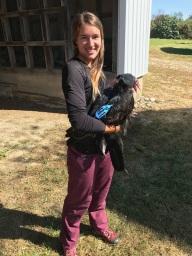
Adehl holds the trapped and newly tagged turkey vulture.
We are confident that this interaction caused us to be unsuccessful in trapping vultures at this trap site, and the second area we chose to bait and trap. As soon as the eagles were seen at the roosting areas, black and turkey vultures were not seen roosting in those locations again during our observations. We did not expect this to occur because in other locations, like the Conowingo Dam in Maryland, eagles and vultures co-exist in the same feeding sites with no apparent issue. We believe the higher tolerance in these areas could be due to a larger food source with enough to go around for everyone, meaning that there is no need to initiate a food fight. The availability of only one carcass at our bait sites and providing large carcasses that were more easily discovered could have been the reason that the vultures and eagles in our study did not get along at our sites. However, all was not lost! In the end we did manage to trap and tag one turkey vulture, which was a very valuable learning experience for Zoey and myself.
Ultimately, I was able to witness unique behavioral patterns through this opportunity that will stick with me the most. I will never forget the breezy autumn morning when over twenty turkey vultures performed aerial acrobatics on a freshly plowed hill between bouts of picking through the soil with their bills and talons. Nor will I forget standing in the pouring rain, watching more than forty black vultures run across the bars of an information tower with their bills clapping and wings spread wide.
Zoey and I learned so much by only taking the time to stop and observe, and we are excited to see what else others that take the time to do the same will discover.
By Zoey Greenberg, Hawk Mountain Conservation Science Trainee
21 Dec 2017
Female black vulture named Donald over a quarry during September of 2016 near Palmyra, PA.
The tires crunched on gravel, and I shut the engine off. We had entered vulture country. With scope, data sheets, and binoculars in hand my project partner, trainee Adehl Shwaderer and I walked carefully up the gravel road as we scanned the tree tops for hunched silhouettes or soaring shadows. This was our first foray into the Kempton Valley, east of Hawk Mountain, in search of black vultures (Coragyps atratus). Our expectations were not high. However, we had innovation on our side: we were testing a method called “groundtruthing” to better understand the movement ecology of several vultures that had been tagged with satellite transmitters by Hawk Mountain scientists. After investigating their movements in Google Earth, we had discovered interesting patterns including an individual who spent time near quarries, and another that seemed to prefer cities. The problem was, we didn’t know why.
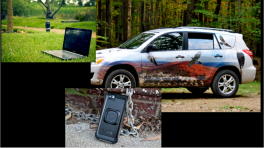
Some tools used for groundtruthing method: laptop, smartphone with hotspot, and a vehicle.
Groundtruthing works like this: we, the field researchers, embark into the field with an internet hotspot and laptop in tow. We look up the locations of tagged vultures on an online database called MoveBank.org and then drive to meet individual birds and watch their behavior. By combining technology with old-school methods, we are able to gain visual access to black vultures and unveil mysteries about their movements that remain when we rely exclusively on satellite tracking data to explore patterns. As I became more comfortable with groundtruthing, I realized that the beauty of the method exists in its simplicity, utility, and the truism that even in this day-and-age there is no substitute for in-person observation.
A wonderful realm of study exists when we move beyond discovering where birds are, and incorporate studies that investigate why. Black vultures provide irreplaceable ecosystem services for us through their removal of carcasses that can carry harmful diseases. However, due to their curious nature and adaptability, they are often involved in conflict with humans that can result in noise-hazing, shooting, and other forms of human persecution. Therefore, investigating their movement patterns is necessary.
Versace’s movements within the Kempton Valley, November, 2017.
At the beginning of our project, we relied on the signals of three birds, Gifford, Hillary, and Versace. (Donald, who turned out to be an adult female, flew to Washington DC after being tagged. We have not heard from her since.) By following these individuals, we discovered three night-time roosts within the first week and I feel confident that any bystander watching our first roost discovery would have been convinced we’d won the lottery. A silent performance of spastic jumping, “air-fives”, and the spontaneous creation of a vulture dance quickly occurred before we got back to business and counted the birds.
In the weeks that followed, we experimented with various observation techniques and read multiple papers on roosting ecology, black vulture foraging strategies, and behavioral study methods. We talked vultures at breakfast, lunch and dinner. We bored our housemates at the trainee residence with discussions on the most pungent types of road kill and the antics of our favorite birds. We filled our brains with vultures, and above all, became true detectives through a process of trial and error that taught us the value of being innovative in the field. Those first weeks were memorable, solidifying in me a hunger for scientific questioning.
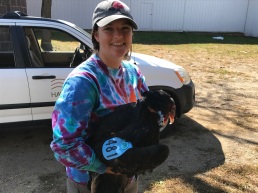
Zoey with a tagged turkey vulture.
There was an additional aspect to this project that I found consistently rewarding: the opportunity to speak with landowners in the Kempton Valley. Many of the roost trees preferred by “our” vultures were on private property, and in addition to observing the birds, we were looking for optimal trapping sites near already-established roosts in hopes of catching wing-tagged birds. This would provide us with information on associations among individuals. However, our trapping method entailed staking road kill to the ground and waiting for vultures to arrive while we waited nearby. In general, people aren’t thrilled about the prospect of hosting dead possums in their backyard. Nonetheless, we were rarely told no. Even landowners who professed a hatred of vultures were open and willing to hear our reasons for loving the birds, and eventually developed a tolerance of their own.
Vultures are hard to sell, and they do have some less-than appreciated habits, such as defecating on cars and toying with the rubber on windshield wipers. However, every “bad” habit has an explanation. For example, vultures are scavengers, meaning they rely heavily on maintaining strong neck muscles for tearing and pulling apart carcasses. To a vulture, rubber is an irresistible training opportunity to both strengthen their neck and satisfy their characteristically curious nature. It became clear that explaining to people why the birds were choosing their property provided them with a new dimension of understanding. This makes groundtruthing not only important for answering scientific questions, but also for enhancing a culture of appreciation around birds that struggle to gain respect. After all, our home ranges overlap with other species, and as such, perhaps we have a duty to critically evaluate our collective perception towards all of our neighbors, including vultures. After spending this season in the field, I am convinced that the Kempton Valley is a perfect place to start.
Conservation science trainees Adehl (left) and Zoey (right) embark on an early morning search.
So what’s next for the vulture detectives you ask? Our field tested method of groundtruthing will be used to fill in more gaps in places with tagged vultures, contributing to our knowledge of why the birds go where they go. Ideally, this information can then be directly applied to informing locals, politicians, conservationists, biologists, and other groups affected by or connected with vultures in their region. As for Adehl and me, early morning roost searches and tactfully placed road kill may remain in both of our futures. There are few sights that compare to a group of dew-covered vultures eyeballing you from above as they slowly swivel their body to absorb the sun’s first rays. With a sight like that there’s only one outcome: once a vulture detective, always a vulture detective.
To learn more about our interesting findings, stay tuned for Vulture Detectives: Part 2 written by Adehl Shwaderer.
By JF Therrien, Hawk Mountain Senior Research Biologist
07 Aug 2017
JF reviews American kestrel nest box data with summer intern Jenna Schlener.
Hawk Mountain has a rich research and monitoring history. For several decades now, on-staff researchers have been carrying the torch, keeping numerous inestimable monitoring projects going. The migration counts conducted at Hawk Mountain indeed represents the longest running raptor monitoring project in the world.
Starting some 80+ years ago, the counts were first designed to assess the usefulness of the protection offered by the newly created Sanctuary. Not long after, Hawk Mountain’s curator Maurice Broun and others realized the invaluable long-term dataset that those counts represent and they could be used to study population trends of 16 North American raptor species. Then in the mid 1950s, Alex Nagy, then Hawk Mountain’s assistant curator, installed a few bird boxes on his farm to see if he could get American kestrels to use them. What most likely started as a humble backyard experiment resulted in what is now the American Kestrel Nest Box Program, which will proudly celebrate its 65th anniversary next spring.
Research and monitoring projects sometimes begin after a carefully designed approach. However, in reality, many such projects simply start serendipitously, as in the previous examples. Traveling around Hawk Mountain to visit the 125 man-made nest boxes of the American Kestrel Nest Box Program during summer 2017, we noticed odd and conspicuous behaviors of bigger, darker birds. Indeed on distinct occasions, black vultures would suddenly appear flying low overhead or even flying out a window from the very barns our kestrel nest boxes are attached to. At that point, we had little doubt; those vultures are likely using the building to nest.
JF holds a newly tagged black vulture named Versace.
From a research point of view, having access to nest sites is highly valuable. In addition to being able to handle adults and chicks to assess their life history traits (body condition, growth rate, disease prevalence, etc.), monitoring nesting activities allows us to assess breeding success and breeding rate, age at first breeding, and nest site fidelity on the population level over time. Those aspects are all immensely important to understand the complete cycle of individuals that compose populations.
Finding this access to several nests for any raptor species is challenging, because individuals are often territorial. Their nests occur at low density and are usually concealed. Therefore, monitoring nesting raptors often becomes an unrealistic task, given the time required and the area that would need to be covered to locate a fair number of them. A good breeding monitoring project requires a relatively easy way to access several nests across a relatively small area to allow researchers to visit them periodically.
Black vulture chick found in a local barn. Photo by J. Dallas.
During summer 2017, our team found just this. We were able to successfully monitor 3 black vulture nests that we found without even searching while checking our kestrel nest boxes. Those birds were using Pennsylvanian barns just like giant man-made nest boxes, and thankfully they were all in a relatively small radius around Hawk Mountain.
This project has just begun, and we are now looking to double or triple the number of monitored nests in the coming years. So if you notice black or Turkey vultures flying out of abandoned buildings or barns, please let us know. We would be thrilled to add new nest locations to our newly-born monitoring program.
Tagged black vulture. Photo by Holly Merker.
By using individual markers (such as wing-tags and telemetry transmitters), we will be following the where and wherefore of those individual birds through their lifetime. Anytime you see a vulture, keep an eye out for wing-tags (a brightly colored tag showing a distinct number). Any sighting of a tagged individual represents important information for locating roost sites, feeding hot spots, survival rates, and dispersal behavior. Help and support these studies by reporting any sightings at this link.
Monitoring programs such as these are an essential part of conservation science: they form the backbone of long-term population assessments. They allow researchers to keep track of historical population size and productivity in order to identify declines in a timely fashion and become aware of problems that otherwise could have gone undetected.
To learn more about our work with North American vultures or any other species of raptors, or if you wish to support our monitoring efforts financially, contact me at therrien@hawkmountain.org.
By Katie Harrington, Hawk Mountain Graduate Student and Former Conservation Science Trainee
10 May 2017
This March I watched three Johnny Rooks feeding in the beached kelp wrack adjacent to a falling tide, with an endless symphonic bray of gentoo penguins in the background. Early afternoon seemed to be the rooks’ final push, as it were, to fill their tanks before tucking in for a late afternoon nap.
A fresh bird with a fresh band; welcome to the world K28 Yellow.
While the adult and two juveniles raked with resolve, another rook, band K28 Yellow, walked to within three feet of me. Unlike times before though, it wasn’t staring at me. K28 Yellow, whose plumage betrayed it’s youth–a fledgling, perhaps having only left the nest just six weeks prior– approached a piece of dried “basket kelp” tucked between driftwood and beach cabbage. Without hesitation, K28 “kick-boxed” the kelp and, clinging to the fibrous ball, fell and rolled onto its back. I watched, trying not to laugh, as it pecked at, clawed, and rolled around with the basket for five minutes, doing what I could only call playing. The raptor, a close relative of the Peregrine and other falcons, reminded me of a puppy consumed with its chew toy.
While extensively studied in mammals, there are far fewer recognized examples of avian play, particularly in raptors. Among birds it is best documented in corvids (e.g. crows and ravens) and parrots. Raptor examples include object manipulation by a captive-raised goshawk, an observation of a wild marsh hawk playing with its horned lark prey, and aerial acrobatics of bald and imperial eagles.
It’s worth pausing here in light of the genetic revelations of the past decade that place caracaras and falcons next to parrots in the tree of life, rather than alongside hawks and eagles. In fact, when reading about the kea, a parrot found only on New Zealand, you could almost replace their species name with “Johnny Rook” and have it read seamlessly. They, like rooks, are highly social, bold, curious, opportunistic foragers that feed on insects just as readily as seabirds and carcasses. And they play, extensively, with other keas and with inanimate objects. These qualities, along with their approachability, make both them and the Rooks the perfect candidates for studying play in the wild.
This occasion of watching a rook play wasn’t an anomaly. Over the two months I spent on Saunders Island this past austral summer (Feb-March), I watched multiple solitary and social play events across all ages of rooks. One time, another recently fledged bird and an adult played with a sheet of plastic stuck in the sand dunes, again rolling onto their backs as they kicked and pulled. For others, old carcasses, long picked clean became ceremonial tug-of war tools. Given the intensity of local fishing, there were also plenty of cast lines that washed ashore, frayed, half buried, just begging to be played with.
Are the birds learning about their environment, building social bonds, or honing predatory or stress responses? At this point, we don’t know. Fortunately, our long-term banding project allows us to track this behavior in specific individuals, creating an unprecedented opportunity to understand the adaptive significance of this behavior in a raptor in the wild. And let’s be honest, what’s more endearing than watching a predator kick its talons up and play?
By Katie Harrington, Hawk Mountain Sanctuary Research Associate
and
Dr. Keith L. Bildstein, Hawk Mountain Sanctuary Sarkis Acopian Director of Conservation Science
Many birds of prey time their feeding efforts to take advantage of the cyclic abundance of their prey. In East Africa, for example, Old World Vultures rush to flight each morning to search for ungulate carcasses created by previous night’s lion and hyena kills. And in Europe and elsewhere rodent-eating Eurasian Kestrels synchronize their feeding efforts to co-occur with the four-hour activity cycles of voles they feed upon. Other raptors, including most notably coastal populations of sea eagles and ospreys, set their hunting efforts to coincide with falling tides, taking advantage of the increased vulnerability of fishes in shallow waters created by the receding waters. And now, thanks to the insightful field observations of former Sanctuary trainee and now graduate student Katie Harrington of San Francisco, raptor biologists can add Striated Caracaras to the list of tidally influenced birds of prey.
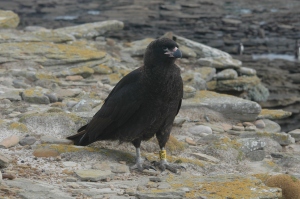
Found only on remote islands in Tierra del Fuego and the Falkland Islands, Striated Caracaras, or Johnny Rooks, are aggressive scavenging birds of prey. Once thought to rummage almost exclusively on dead and dying seabirds and livestock (including penguins and sheep), human leftovers, and occasionally, marine-mammal feces, we have discovered that these cunning birds of prey also take a many kinds of terrestrial invertebrates, including both earthworms and grass grubs, and as well many intertidal invertebrates, including dipteran kelp maggots, limpets, barnacles, and even—believe it or not—octopuses.
The early bird gets… the octopus. The first two rooks on the scene dislodge the marine predator from where it was sheltering in a tide pool and begin consuming its tentacles.
One of the primary efforts of our most recent field efforts on Saunders Island, in the Falkland Islands where roughly 150 Johnny Rooks spend the summer months, was to learn more about the importance of invertebrates in the Rooks’ diet. What factors influence the amount of time Rooks spend foraging for invertebrates each day, and does this strategy provide an ecologically significant amount of nutrition? To find out, we spent hours observing the Rooks raking for maggots in accumulated, decomposing kelp wrack, some determinedly excavating pits six inches deep, and many digging shoulder to shoulder for over an hour. During one mid-afternoon observation session, we observed what appeared to be a shift in their preferred entrée. The Rooks exited the kelp wrack and flew toward an adjacent rocky intertidal zone that was being slowly exposed by the falling tide. First one, then four, then up to twenty birds entered the rocky area, both by flight and by their often-preferred method of walking and running.
In less than a minute, the word is out, and more than 10 Johnny Rooks surround the octopus. Many of the juveniles in this group were banded earlier this year.
Previously submerged, the rocks began to provide a platter of meal options, from blanketing mussels to limpets to innumerable species of invertebrates sheltered under flat rocks. We watched as the rooks began silently and systematically walking along the waterline, peering under overhanging rocks in search of limpets that had not yet suctioned tightly to survive the low tide. Unlike their foraging strategy within the kelp wrack, which can reach as many as fifteen individuals raking within 2 meters of each other, the Rooks searched the intertidal as individuals or in small, mixed-age groups. As the tide fell further, some even alit on the partially exposed adjacent kelp forest, searching the algae’s stipes for potential prey. Their persistence paid off as we watched many quickly consuming their quarry, some within two minutes of their previous catch.
Less than fifteen minutes from the time the Rooks shifted into the area, a juvenile bird encountered a Southern Red Octopus caught in a tide pool. The Rook immediately pulled the octopus up onto a rock where it laid overturned, struggling to right itself as nine juveniles began pulling on and partitioning its tentacles. Within six minutes, more than thirty Rooks encircled the octopus, which had been reduced to portions of its head, with which individual Rooks were then able to abscond. With full crops, the group dispersed, some Rooks sheltered aside nearby ledges to digest while others retreated to a fresh-water seep on the adjacent cliff to wash down the meal.
Previously, the only known predators of the Southern Red Octopus were Southern Sea Lions and humans that opportunistically fish for them during spring tides; yet the speed at which the Rooks dispatched the octopus suggested this was not the first time they had encountered the eight legged invertebrate. Octopus may be clever, but they have met their match in the Johnny Rook.
Dr. Keith Bildstein about to release one of the northern breeders this January.
By Keith L. Bildstein, Ph.D., Sarkis Acopian Director of Conservation Science
Hawk Mountain Sanctuary
17 March 2017
Most studies of bird migration focus on the movements of birds that ornithologists refer to as “complete migrants,” species whose global populations evacuate their breeding grounds each year while traveling to geographically distant wintering areas. Although Arctic Terns, Black-and-white Warblers, and Broad-winged Hawks, along with a small percentage of other species of migratory birds, do follow this pattern, most migratory species of birds are “partial migrants,” species whose populations include both sometimes-migratory and non-migratory individuals, and whose migratory populations sometime overwinter in areas already occupied by non-migratory members of the same species. It turns out that partial migration is a lot more complicated than complete migration, and although the former is little studied compared with the latter, its complexity makes it a lot more intriguing, as well as a lot more challenging, both to investigate and to understand.
New World Turkey Vultures are a good example of partial migrants, with some populations consisting entirely of migratory individuals, whereas other populations consist of both migratory and non-migratory individuals, and still other populations consisting entirely of non-migratory individuals. The degree to which different populations of Turkey Vultures interact, and the effects they have on each other is not well known. One place where such interactions have been explored is in the Llanos, the enormous freshwater wetland of central Venezuela, where Turkey Vulture migrants from western North America, which are larger and more massive than the region’s non-migratory, year-round residents, displace the latter from the best available habitats and gain weight after their arrival while the supplanted residents simultaneously lose weight. Indeed, the so-called Llanos “residents” appeared to “migrate reciprocally” to avoid competing with of the larger North American birds.
But what happens in areas in which some breeders migrate south in autumn, whereas other stay put, while still others from more northern breeding sites migrate into the region and over-winter there? Such is the case in the Sonoran Desert of southwestern Arizona, where members of the breeding population include both migrants and non-migrants of the aura race of Turkey Vultures, whereas as the winter-only individuals are migrants from the larger and more massive meridionalis race from farther north. (Note: There are six subspecies of Turkey Vultures, three that breed in North America, along with two that breed in Central America, and three that breed in South America.)
Keith and Hawk Mountain Sanctuary Senior Researcher Dr. Jean-Francois Therrien fitting a satellite to one of the norther breeders this January.
We began satellite tracking members of the Sonoran Desert breeding race in 2014 and have followed the movements of nine birds since then. All but one have proved to be migratory, with some individuals overwintering consistently in Mexico, whereas other have overwintered consistently either in Guatemala, El Salvador, Panama, or Colombia. In late January of this year my Hawk Mountain colleague, Dr. Jean-Francois Therrien, and I traveled to our tapping site outside of Phoenix and successfully trapped two winter-only individuals of the meridionalis race of Turkey Vultures. Although we don’t know exactly where these two breed, as of early-March one was on Vancouver Island in south western most Canada, and the other was in Death Valley California in late March, with both north of their Arizona trapping site.
Tracking the movement of all of these Sonoran birds for several years will allow us to determine if the northern breeders crowd out the smaller year-round residents from Arizona, and if so, whether or not the smaller southern migrants leave in autumn in advance of the arrival of the larger northern migrants and time their returns to avoid the departing northern migrants in spring.
Although this may seem a bit esoteric to some, understanding the extent to which the two subspecies interact in the Sonoran Desert has important implication for conservation. Suppose, for example, that in Arizona the larger northern breeders consistently dominate the smaller southern breeders. If so, the size of the former’s populations could limit the size of the latter’s, particularly in winter when food may be limiting. If so, the fate of the latter would be affected by the fate of the former. Thus, if global change were to affect the former–either positively or negatively–the latter might “respond” as well, albeit indirectly, in-kind. Although, all of this remains highly speculative, the extent, if any, to which populations of the two races merits examination, and I very much look forward to doing so over the course of the next few years.
I will keep you posted of the arrivals and departures of both our “northern” and “southern” Arizona migrants this summer.










 The Vulture Chronicles